Goals don't grow businesses. Constraints do.
I work with 8 and 9-figure operators to find the single constraint slowing your system, work with your team to fix it, then systematize so it stays fixed. The result is what every operator actually wants and almost none have: predictable, compounding growth.









The biggest misconception in growth.
…is that it happens by focusing on goals.
Set a number. Build the team to hit it. Stack the tools. Hire the heads. Add the systems. Repeat. It's the playbook every advisor, every podcast, every quarterly OKR template will sell you.
It's also how every operator I've ever worked with ended up in the same room: payroll heavier than ever. More software than ever. Goal post somehow further than ever. Profit margin somehow smaller.
Not because you did anything wrong. Because this is how you were trained — by every business book, every operator coach, every "set bigger goals" sermon. Aim at the goal. Resource against the goal. Hit the goal.
The problem is none of it actually moved the constraint.
You can't outrun your opex.
Every dollar you add in resources has to be matched by more than a dollar in revenue — or your margin shrinks. Most operators don't realize they're losing this race until they're three quarters deep into a hiring sprint that didn't move the line.
This is why most businesses don't make it past 9 figures. Not strategy. Not product. Not market. They tried to scale a system that had a structural weakness — and the weakness scaled with them.
Think about it this way. A business is a system designed to produce a goal. For a while, your system worked — the team was small enough, the offer was sharp enough, the bottleneck didn't matter at your size. Over time the system accumulated drag. A fulfillment choke point here. A comp plan that incentivizes the wrong outcome there. A team structure that no longer maps to how the business actually runs.
The system is now leaking. And every new resource you pour in leaks with it.
You can't grow your way out of a broken system. You can only fix it.
Remove the weakest link.
The only way for a system to grow is to identify and remove the single weakest link in it. Not the second-weakest. Not the loudest. Not the most fashionable. The actual constraint — the one part of the system that's choking everything else.
This isn't a theory. It's the operating principle behind every well-run factory floor on Earth. Eliyahu Goldratt codified it 40 years ago in The Goal — required reading for serious operators since. The same logic applies to your business: the chain is only as strong as its weakest link. Add weight to a chain with a weak link, and the link snaps. Not the chain.
So the sequence is:
- Find the weakest link.
- Create the plan to fix it.
- Fix it before adding any new resources.
- Then — and only then — add weight to the chain.
Most businesses skip step three. They identify the problem, build a plan, and immediately try to hire or buy or tool their way out before the fundamental fix is in. That's how you end up with a chain full of weak links and a team that's confused about why nothing's working.
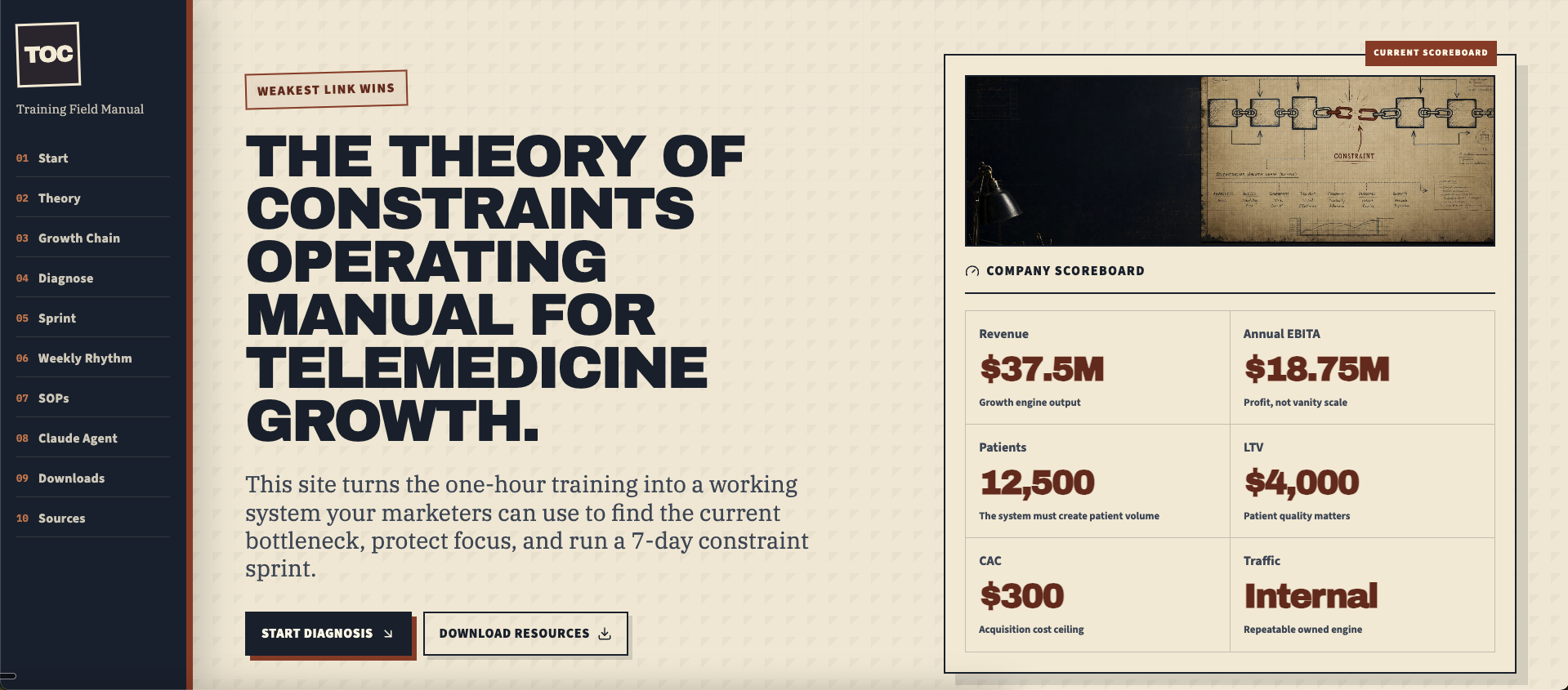
Your chain gets stronger. Your math gets predictable.
Repair one weak link and the system's capacity jumps. Repair the next, and it jumps again. Eventually you stop being surprised by what the business can do — you know, with arithmetic-level confidence, how much weight the chain can hold this quarter, next quarter, this year.
That predictability is the actual prize.
It's what lets you commit to a number with your board and hit it. It's what lets you greenlight a hire without crossing your fingers. It's what lets you build a 12-month plan instead of a 90-day prayer. The business stops feeling random — because it stops being random.
That's goal velocity. Not faster growth for its own sake. Predictable, compounding growth that compounds because the system underneath has been engineered to hold the weight.
You need someone outside the system to see it clearly.
Your team can't see the constraint. Not because they're not smart — because they're inside the system, and the system has trained them to see the problem the way it wants to be seen. Every operator I've ever worked with had a confident answer to "what's slowing you down?" that turned out to be wrong on inspection. That's not a knock on the team. That's how systems work.

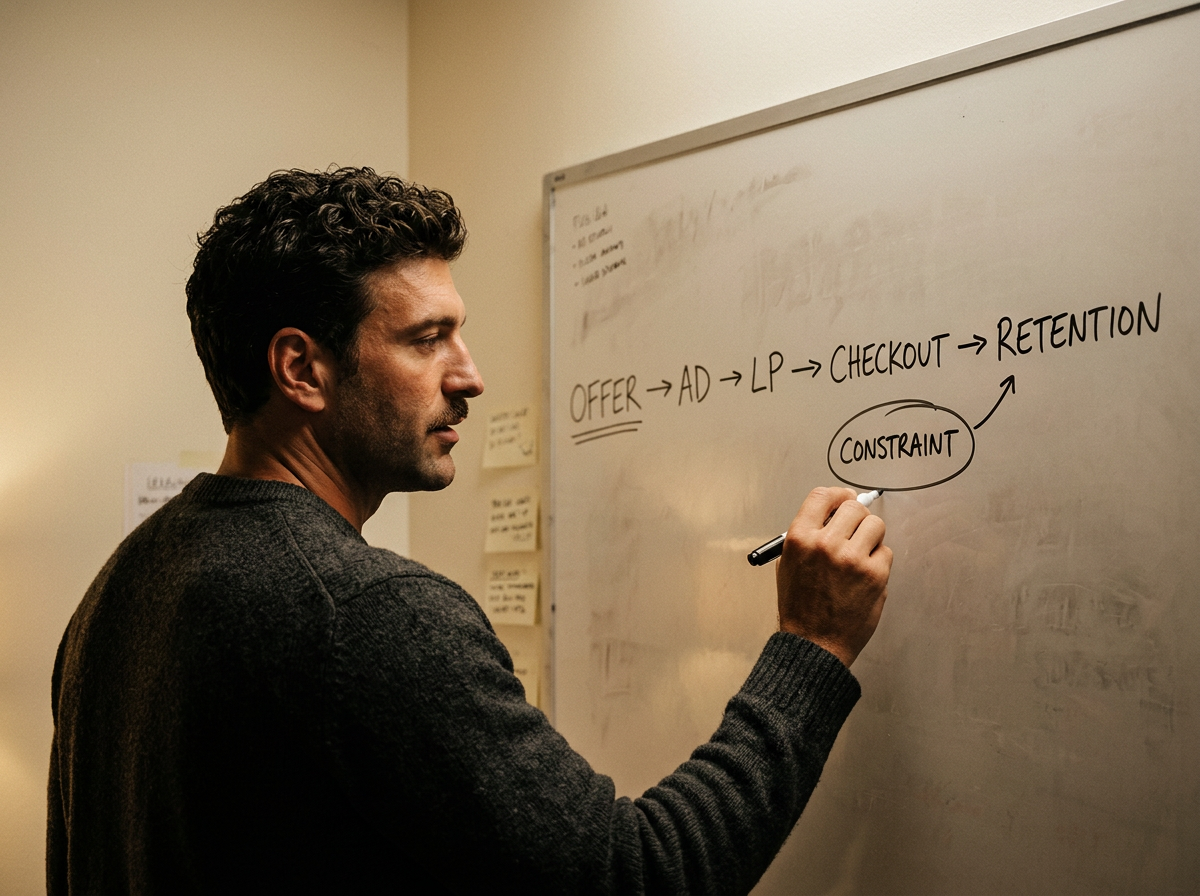
My job is to be the outside operator who walks in, refuses to optimize the loudest problem, finds the actual constraint, works alongside your team to fix it without breaking the rest of the system — and then systematizes the fix so it sticks.
I've done this for 8 and 9-figure operators across supplements, info-product, telehealth, services, and capital. I'm not theorizing. I run the same playbook in my own businesses — Acquisition Systems in performance marketing, alongside Rich Schefren at Strategic Profits, and inside ZenithPro with founders scaling toward seven figures. When I prescribe AI, I've already built and shipped it in production.
Operators I've worked with.
Direct engagements and partnerships across supplements, info-product, telehealth, services, capital, and platform companies. Specifics on the work itself live in the case studies.
Here's how I run this.
Same six steps, every engagement. The order is sacred — skip a step and the system reverts.
Audit
I come into the company and look at your goals, your numbers, your team, and your systems. Not a Zoom call. Two weeks inside the actual machine. First assessment in hand by day 14.
Align on goals
We get crystal clear on where you actually want the business to go. Not the goal you wrote on a wall in 2022. The number you'd bet your name on for the next 18 months. The constraint we're solving for has to map to that number.
Identify the constraint
Working with your team, I find the actual constraint slowing growth. Usually not where anyone has been looking. Usually obvious in hindsight.
Map the play
We architect the exact play to solve it — in the right order, with the right metrics, with the right kill criteria. Sequence matters. Subordinate before you elevate. Exploit before you add.
Systematize for scale
Implement an AI-powered system to make the solution stick without adding another tool for you to manage or another seat to your payroll. The system runs the fix. Your team runs the business.
Accelerate momentum
Repeat the loop. A new constraint surfaces every quarter or two. We move with it. Each loop strengthens the chain — and your math gets more predictable every time.
Not for everyone. On purpose.
This works if you
- Run a brand or business at 8 or 9 figures of revenue
- Have an actual team, actual data, actual customers
- Are tired of working harder for shrinking margin
- Trust mechanism over magic
- Want to be in the room when the constraint gets named
This doesn't work if you
- Are pre-revenue or sub-7-figures (the audit will reveal less than it should)
- Want a fractional CXO to run your business for you
- Need a board deck more than a real answer
- Think AI fixes things on its own (it doesn't)
- Find Theory of Constraints "academic"
The questions I get every week.
Find your constraint. Strengthen your chain. Compound the growth.
The audit is where it starts. Two weeks inside the machine. One deliverable: your business's actual constraint, named, with the play to break it.
Apply to Work With Me → Limited to a small number of operators per quarter