How it actually runs.
TOC isn't a metaphor. It's a sequence. Here's the exact one I run — what happens, when, what you get, and how we know it's working.
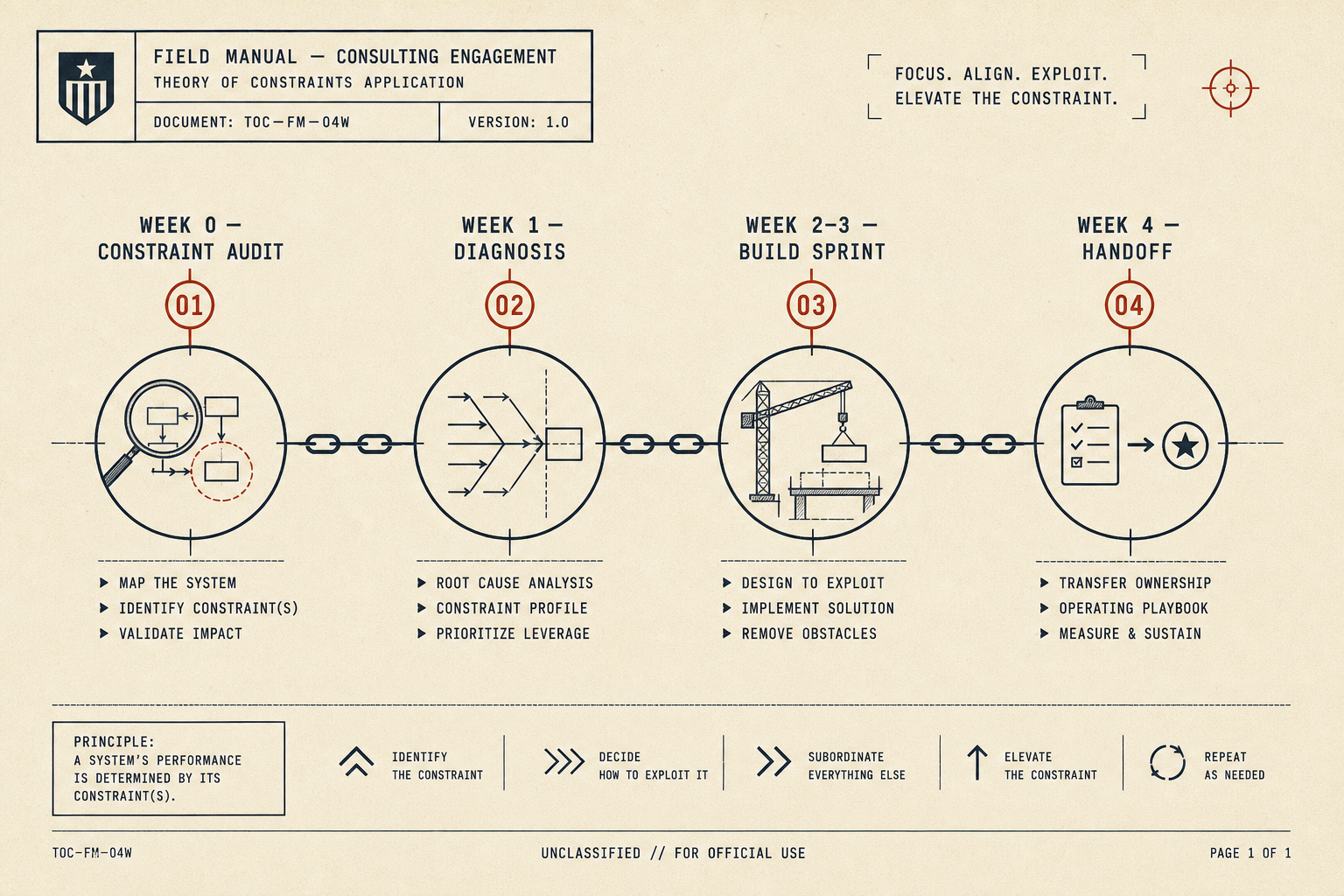
14 days. Two weeks of work. One document.
The audit is the entry point and the test. You hire me to find the slowest part of your system — the part choking the rest. If I can, it's usually worth more than the fee on the first read-through.
- DAY 1Access. You give me read-only access to whatever runs the business — ad platforms, CRM, Shopify or Stripe, your analytics, your Slack, your project tracker. I'm inside the actual machine, not a sanitized version of it.
- DAYS 2–4Number diving. P&L by SKU, cohort retention, CAC by channel, fulfillment latency, refund and churn patterns, team capacity vs throughput. I'm not building a deck. I'm hunting for the asymmetry — the place where 10% of the system is dragging 90% of the result.
- DAYS 5–7Team interviews. 30 minutes each with 3–5 people on your team. Not your leadership. The people doing the work — fulfillment, support, media buying, account management. The constraint usually shows up in their daily friction, not in the dashboards.
- DAYS 8–11Hypothesis testing. I take three or four candidate constraints and stress-test them against the data. The real constraint is the one where, if you ran the numbers forward 90 days, breaking it changes the line and nothing else does.
- DAYS 12–13The deliverable. A single PDF, usually 12–18 pages. Section one: your constraint, named, with the evidence. Section two: why your team has been missing it. Section three: the play to break it — exact moves, sequence, metrics. Section four: what happens after the constraint moves.
- DAY 14The walkthrough. 60 minutes on Zoom. We walk through the document together. You ask everything you want. At the end, you have a named constraint, a play, and zero obligation to keep working with me.
90 days. Sequenced moves.
Most operators leave the audit and execute the play themselves. Some want a tighter blueprint before they move. The Strategy Map is that blueprint.
It's not a deck. It's a working document — the exact 90 days of moves required to break the constraint you just paid me to find. Sequence matters. Goldratt was clear on this: exploit before you elevate, subordinate before you add. Skip a step and the system snaps back.
Inside the map: the order of operations, who does what, the metrics that say it's working, the kill criteria that say it isn't, and the contingency play if the constraint turns out to be one layer deeper than the audit suggested.
Quoted after the audit. You only buy this if you want the depth — many operators don't need it.
In your Slack. Running the constraint.
This is where most clients live. We run the constraint together — every week, for as long as the work makes sense.
Weekly working session
60–90 minutes every week. Not a status meeting. A working session. We review the constraint, the metrics, the friction, and the next move. You leave with three things to do and clarity on which one matters most.
Slack channel
I'm in your team Slack. When something breaks or a decision needs another set of eyes, you tag me. Most responses inside two hours during weekdays.
Constraint dashboard
One dashboard. Five to seven metrics that tell us whether the constraint is moving. Built in whatever you already use — usually a Looker, Posthog, or Notion view. We don't build new tools to track work. We track the work.
Constraint review
Every 90 days, the system has rearranged. A new bottleneck has usually appeared. We sit down for a half-day, identify the new one, and rewrite the play. This is the part most consultants skip — and the part that compounds the work.
When the play needs to be built.
Some constraints need a hire. Some need a system. Some need both. When the play requires building — and you don't want to learn n8n at 2am or interview eight marketers to find one good one — I do it or oversee it directly.
AI systems built end-to-end
Custom n8n workflows. Pinecone-backed knowledge systems. Claude-driven content engines. Voice and SMS agents through VAPI. Whatever the play requires. Built by someone who runs these systems in their own businesses every day — not someone who watched a YouTube video about them.
Marketers sourced, vetted, trained
If the play is a media buyer, a copywriter, a CRO specialist, or a fractional head of growth — I source them, vet them, and train them into your context. Same network I use to staff Acquisition Systems.
Whatever the constraint demands
Sometimes the play is a rewritten welcome sequence. Sometimes it's a new offer page. Sometimes it's killing a SKU. The mechanism dictates the work, not a service menu.
Tools I build with. And operate with.
When AI is the right answer for the constraint, this is the stack I reach for. I use these in my own businesses every day. Nothing on this list is on it because of a sponsorship or a referral fee.
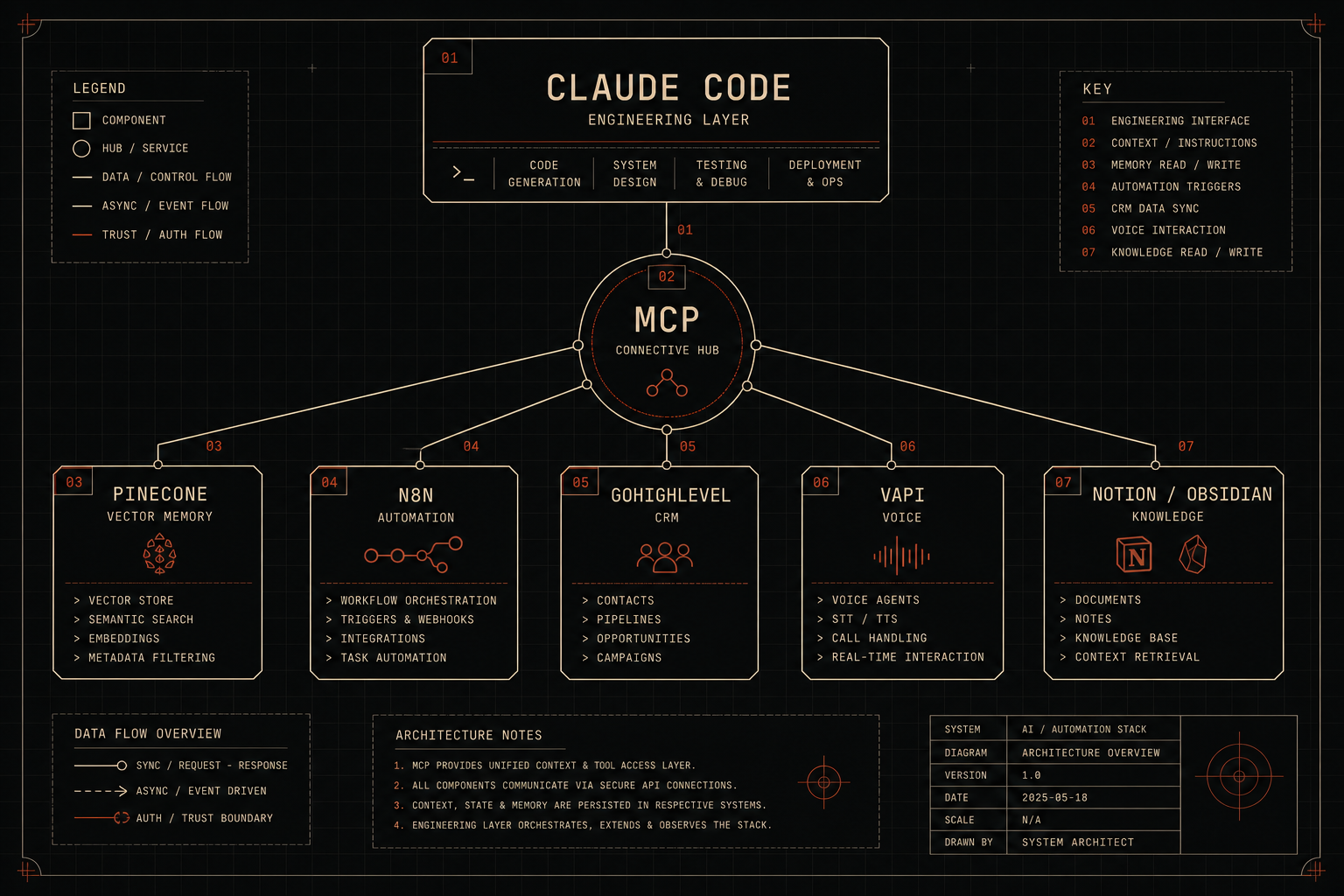
If your constraint doesn't need AI, none of this gets touched. The tools serve the constraint, not the other way around.
The audit is where it starts.
Two weeks inside the machine. One deliverable.
Apply for the Audit → Limited to a small number of operators per quarter